

Rastgele sayıların plain text ile her seferinde bir bit XOR’lanacak şekilde şifrelenmesi VE aynı rastgele sayılar kullanılarak şifresinin çözülmesi işlemidir. Rastgele sayılar genelde pseudo number’dır. Belli bir seed value ile her zaman aynı rastgele sayıları üretir. Bu seed value bizim anahtarımız olacaktır.
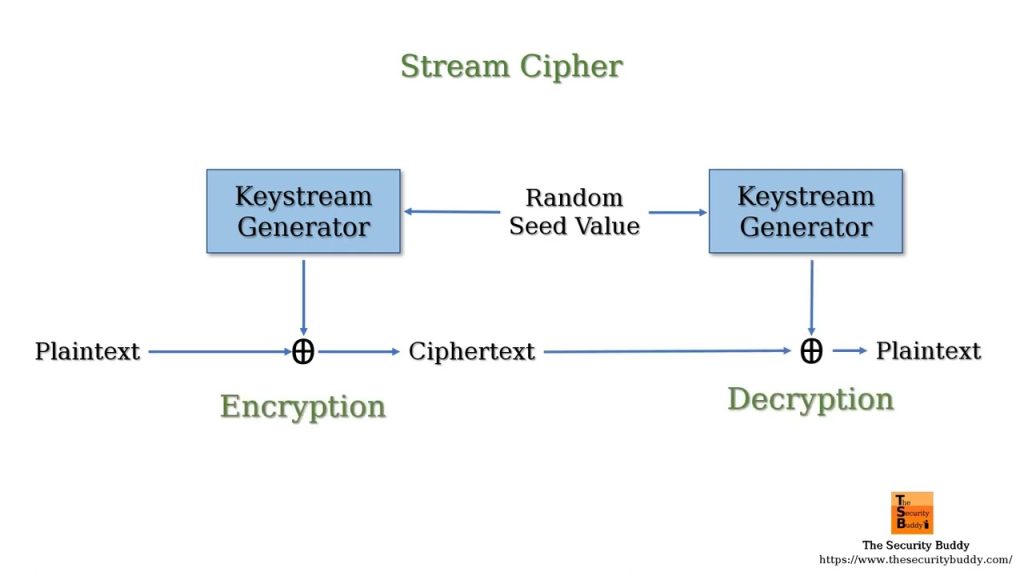
A stream cipher is a symmetric key cipher where plaintext digits are combined with a pseudorandom cipher digit stream (keystream). In a stream cipher, each plaintext digit is encrypted one at a time with the corresponding digit of the keystream, to give a digit of the ciphertext stream. Since encryption of each digit is dependent on the current state of the cipher, it is also known as state cipher. In practice, a digit is typically a bit and the combining operation is an exclusive-or (XOR).
The pseudorandom keystream is typically generated serially from a random seed value using digital shift registers. The seed value serves as the cryptographic key for decrypting the ciphertext stream. Stream ciphers represent a different approach to symmetric encryption from block ciphers. Block ciphers operate on large blocks of digits with a fixed, unvarying transformation. This distinction is not always clear-cut: in some modes of operation, a block cipher primitive is used in such a way that it acts effectively as a stream cipher. Stream ciphers typically execute at a higher speed than block ciphers and have lower hardware complexity. However, stream ciphers can be susceptible to security breaches (see stream cipher attacks); for example, when the same starting state (seed) is used twice.
Leave a Reply